


Air Conditioner Repair Secrets Your Tech Won’t Share
When your AC stops cooling on a hot Tennessee afternoon, panic kicks in fast. You call the first technician you find, accept whatever quote they offer, and hope for the best. But here’s the truth about air conditioner repair that most companies won’t tell you: a lot of emergency repairs are simple fixes, and a lot of necessary replacements aren’t actually necessary. Knowing the difference can save you hundreds, sometimes thousands of dollars a year.
This guide pulls back the curtain on what technicians know but rarely share with homeowners. You’ll learn what you can troubleshoot yourself, what justifies a service call, and how to spot the upsell tactics that drive your bill up. If your unit is already acting up and you want a straight answer, reach out today for an honest diagnosis before you commit to anything.
Why Air conditioner repair Costs So Much (And Where the Markup Hides)
The HVAC industry runs on emergencies. When you’re sweating in a 90-degree house, you’re not negotiating, you’re paying. That dynamic shapes pricing in ways most homeowners never see.
Here’s where costs actually come from on a typical repair call:
- Diagnostic fee: $75 to $150 just for someone to look at the unit
- Parts markup: Often 2x to 4x the wholesale cost
- Labor: $100 to $200 per hour after the first hour
- “Recommended” add-ons: Coil cleaning, capacitor “upgrades,” surge protectors
Not all of these are bad. A reputable technician earns their fee. But the markup on parts is where the biggest gaps appear between honest companies and predatory ones. A $20 capacitor can show up on your invoice at $180. A $90 contactor can become $400.
The fix isn’t to avoid professionals. It’s to understand what you’re paying for so you can ask the right questions.
Call Us: (615) 568-7450
The Most Common AC Problems (And Which Ones You Can Handle Yourself)
Before calling anyone, run through these basics. A surprising percentage of “broken” AC units have one of these simple issues.
Dirty or Clogged Air Filter
This is the number one cause of AC problems, and it’s the cheapest to fix. A blocked filter restricts airflow, freezes the evaporator coil, and eventually trips the system off entirely.
What to do: Check the filter. If you can’t see light through it, replace it. Filters should be changed every 30 to 90 days depending on type.
Thermostat Issues
Sometimes the AC is fine and the thermostat is the problem. Dead batteries, wrong settings, or a thermostat installed in a sunny spot can all trigger calls that aren’t actually AC failures.
What to do: Replace batteries, confirm it’s set to “Cool” not “Fan,” and check that the temperature setpoint is below room temperature.
Tripped Breaker
AC units pull heavy current and occasionally trip the breaker, especially during voltage fluctuations.
What to do: Check your electrical panel. If the breaker has tripped repeatedly, stop resetting it and call a professional. Repeated tripping signals an electrical issue.
Frozen Evaporator Coil
If you see ice on the indoor unit or refrigerant lines, the system has frozen up. Common causes are dirty filters, low refrigerant, or restricted airflow.
What to do: Turn the AC off, switch the fan to “On” to thaw the coil, and replace the filter. If it freezes again, call a technician.
Outdoor Unit Issues
Dirty condenser coils, debris around the unit, or a failed capacitor can all stop the outdoor unit from working properly.
What to do: Clear leaves and grass clippings from around the unit. Gently rinse the coils with a garden hose (power off first). If the fan still doesn’t spin, that’s a professional call.
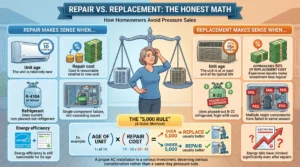
Repair vs Replacement: The Honest Math
This is where homeowners get pressured the most. A technician shows up, declares the unit “at end of life,” and pushes a $7,000 to $12,000 replacement. Sometimes that’s right. Often it isn’t.
Here’s the comparison that actually matters:
Repair makes sense when:
- The unit is under 10 years old
- The repair cost is less than 30 percent of replacement cost
- The system still uses current refrigerant (R-410A or newer)
- The failure is a single component, not a cascading issue
- Energy efficiency is still reasonable for its age
Replacement makes sense when:
- The unit is 12 to 15 years old or older
- The repair cost approaches 50 percent of replacement cost
- The system still uses R-22 refrigerant (phased out and expensive)
- Multiple major components have failed in the same season
- Energy bills have climbed significantly even after repairs
The “5,000 rule” is a useful shortcut. Multiply the age of the unit by the repair cost. If the number is over 5,000, replacement is usually the better call. If it’s under, repair wins.
A proper AC installation is a serious investment, so it deserves serious consideration rather than a same-day pressure sale.
The Industry Secrets Worth Knowing
These are the things technicians know but don’t always volunteer.
Refrigerant doesn’t “run out.” AC systems are sealed. If yours is low on refrigerant, there’s a leak somewhere. Adding more without finding the leak just means you’ll be paying for refrigerant again next season.
Capacitors are the most over-sold part. They do fail, but they’re often replaced when they’re still within spec. Ask the technician to show you the meter reading, not just tell you it’s bad.
Annual maintenance prevents 80 percent of emergency calls. A 30-minute tune-up catches problems before they become $1,500 repairs. AC maintenance pays for itself in avoided emergencies alone.
Bigger isn’t better. An oversized AC unit cools the air too quickly, shuts off, then cycles back on constantly. This wears out components faster and leaves humidity behind. Proper sizing matters more than capacity.
Free estimates aren’t always free. Some companies offer free estimates only on replacements, then charge a hefty diagnostic fee if you decline. Confirm pricing before they show up.
Common Mistakes That Cost Homeowners Money
- Ignoring strange sounds. Grinding, hissing, or clicking sounds are early warnings. Addressing them early costs less than waiting for full failure.
- Skipping yearly maintenance. Skipping a $169 tune-up to save money usually leads to a $1,200 repair within 18 months.
- Closing vents in unused rooms. This doesn’t save energy. It increases pressure in the ductwork and stresses the blower motor.
- DIY refrigerant work. Handling refrigerant requires EPA certification. It’s also genuinely dangerous if mishandled.
- Hiring based on price alone. The cheapest quote often comes with the lowest-quality parts and shortest warranty.
- Not getting repairs in writing. Always get a written estimate with itemized parts and labor before work begins.
How to Choose a Repair Company You Can Trust
The HVAC industry has plenty of honest companies and plenty of predatory ones. Tell them apart by checking these signals:
- Licensing and insurance. Confirm both, and ask for current certificates.
- Local physical address. Not a P.O. box or out-of-state contractor.
- Transparent pricing. Diagnostic fees, hourly rates, and parts pricing should be available before they arrive.
- Itemized written estimates. Vague “system repair” line items are a warning sign.
- Verified reviews. Look at patterns across customer reviews, not just star ratings.
- Manufacturer certifications. Factory training matters, especially for newer high-efficiency systems.
- Reasonable warranty terms. Quality companies stand behind their work for at least one year on labor.
If you’re in the Middle Tennessee area and need AC repair in Spring Hill, the same rules apply. Local matters because warranty service depends on the company still being around in two years.
When You Really Should Call a Professional
DIY has limits. Call a professional when you see any of these:
- Refrigerant leaks or oily residue on lines
- Electrical issues, including repeated breaker trips
- Compressor problems (loud hum without cooling)
- Repeated freeze-ups after filter changes
- Burning smells or smoke from the unit
- Water leaks beyond a clogged condensate line
- Any work requiring sealed-system access
These aren’t areas to experiment. They involve high voltage, regulated refrigerants, or critical safety components.
FAQs About Air Conditioner Repair
How to choose a reliable air conditioning repair company?
Look for proper licensing, a local physical address, transparent pricing, and consistent positive reviews. Avoid companies that pressure you into same-day decisions or won’t provide written estimates.
What questions should I ask my HVAC technician?
Ask for the specific part number being replaced, the warranty on parts and labor, whether the diagnostic fee applies to the repair, and whether they’ve shown you actual meter readings to confirm the diagnosis.
Average cost to repair an air conditioner?
Most air conditioner repair fall between $150 and $650. Capacitor replacements run $150 to $400, fan motors $300 to $700, and refrigerant leaks $500 to $1,500 depending on location. Compressor replacement is the most expensive at $1,500 to $3,000.
Why is my AC unit not working? Common problems explained.
The usual culprits are dirty filters, thermostat issues, tripped breakers, frozen coils, low refrigerant from leaks, or failed capacitors. Start by checking the filter and thermostat before assuming the worst.
How long should an air conditioner last?
A well-maintained central AC system lasts 12 to 17 years. Units that get annual maintenance often reach the upper end of that range. Units that don’t usually fail somewhere between years 8 and 12.
Final Thoughts
Air conditioner repair doesn’t have to mean overpaying. Know the basics, ask the right questions, and work with a company that explains what they’re doing instead of pressuring you. A little knowledge changes the entire dynamic of the service call.
If your AC is acting up and you want a straightforward diagnosis without the hard sell, True Blue Heating and Cooling is here to help. Reach out today and get an honest assessment from a team that treats your home like their own.
Call Us: (615) 568-7450