


Should I cover my AC unit for winter in Tennessee?
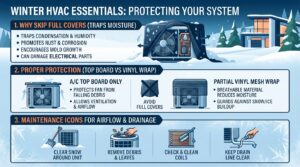
If you searched for whether you should cover your AC unit for winter, the short answer is no. A heat pump must never be covered while it is in use, because the outdoor coil needs airflow all winter. A cover on a cooling-only air conditioner is less dramatic, since that unit sits off for the season, but a tight cover holds moisture against the coil and cabinet, which is where rust starts.
The question arrives every September here. On 21 September 2026, highs across Columbia, Franklin, and Nashville were still running 94.6 to 96.4 F with humidity between 79 and 90 percent, and by the weekend of 26 to 27 September, overnight lows are forecast to fall to 55.1 to 62.5 F.
Why the cover advice exists at all
The instinct is reasonable. An outdoor cabinet sits under the trees, catches leaves through October, and takes the worst of a Tennessee ice storm across the top. Cover listings show a snow-covered unit on the package, and someone who moved here from a colder state might assume a cover belongs there.
The advice went wrong when it got applied to every unit. In Middle Tennessee, a heat pump often runs as the primary heat source from the first cold night in October through March. A cover is harmless on equipment that sits idle. It is a problem with equipment that has to run.
Why the answer to “should I cover my AC unit for winter” depends on your equipment
A heat pump moves heat instead of creating it. In heating mode, the outdoor coil sits colder than the outside air, which is how it absorbs heat from that air, and the outdoor fan pulls air across the coil to keep the exchange going. Restrict the airflow and the coil cannot do its job. Pressures climb, the compressor works harder for less heat, and the strain lands on the coldest nights.
Cover a running heat pump, and the sequence is predictable. Airflow drops, frost builds faster than the unit can clear during defrost, the safety controls register the abnormal pressure, and the unit shuts down. Homeowners find out at six in the morning with the house in the low sixties. Defrost matters here too. The unit briefly warms the outdoor coil to melt frost, and that meltwater drains the bottom of the cabinet. Cover the top, and the water has nowhere to go.
The cooling-only case: what a cover does and does not protect
If the outdoor unit is a straight cooling air conditioner paired with a furnace, the compressor is off from late fall until spring, so a cover will not shut anything down. Under a tight cover, the cabinet and coil warm and cool with the weather; moisture collects on the metal and inside the fins, and no airflow dries it out. Steel rusts at the seams and around the bottom pan, and the aluminum fins corrode.
A covered unit is also a dry, quiet box at ground level, and mice will use it. Rodents chew the low-voltage control wires that run into the cabinet, and that repair usually shows up in May as a no-cooling call.
| Situation | Cooling-only AC (off for the season) | Heat pump (runs all winter) |
| Will a full cover shut the system down? | No, the compressor is off | Yes, and it may trip a safety limit |
| What the cover blocks | Leaves, snow, and sleet | Leaves, snow, and the airflow the coil needs |
| Main risk | Condensation against the coil and cabinet, rust, rodent and insect shelter | Starved airflow, rising pressures, defrost water trapped in the cabinet |
| Better option | A top-only cover or a rigid panel with open sides, or nothing at all | Nothing at all, with the area cleared |
A top-only cover or a rigid panel that sits across the top sheds leaves and keeps ice off the fan guard while the sides stay open. Some homeowners cut plywood to fit and weight it down. Others leave the unit alone and rake around it in November. What you want to avoid is wrapping the cabinet in vinyl and leaving it there until spring.
What actually protects the equipment through winter
What matters is airflow and drainage rather than concealment. Clear at least two feet of space around the unit on every side, and keep the top clear, because a heat pump discharges air upward. Rake the leaves out of the cabinet, since wet leaf litter packed into the fins blocks airflow about as well as a cover. Cut back the shrubs and grasses that grew into the unit over the summer.
Check the pad the unit sits on. A cabinet that has settled out of level strains the refrigerant lines, so mention it at your next heat pump maintenance or AC maintenance visit. Look at the insulation on the lineset where it runs into the house, because cracked or missing foam lets the line lose heat.
Keep storage away from the unit. Firewood, bags of mulch, and trash cans end up leaning against the cabinet and blocking airflow. After a snow or ice event, clear the snow with a broom, and never chip ice off the coil. If the unit is iced solid, leave it alone and call.
Pre-winter checks that matter more than a cover
A heat pump winter preparation routine takes about twenty minutes, and none of it involves a cover. Change the filter, since a clogged filter restricts airflow through the indoor coil in heating season too.
Set the thermostat for the season. A heat pump recovers slowly, so a large overnight setback often brings the electric backup heat and undoes the savings. Our thermostats page explains the settings.
Test the heat before you need it. On a mild afternoon, switch to heat and let it run for a few minutes. A dusty smell on the first heat of the season is common and fades, so watch for air that never warms.
Listen to the system. Rattles, grinding, a hum that was not there last year, and the outdoor fan striking ice all mean something. A heat pump is louder during defrost by design, so judge it against last winter.
Watch the ice. Frost on the outdoor coil is normal, and the unit clears it on its own. Ice that stays for hours or builds on the fan guard is not normal, and ice storms are the usual cause here. Our FAQ covers other warning signs.
When to call a technician
Call us if the house has no heat, if the outdoor unit stays iced over for hours, if the system runs constantly and never reaches the setpoint, or if it trips the breaker. Repeated breaker trips point to an electrical or compressor problem that will not fix itself with another reset. A technician provides an estimate after inspection. Reach our Columbia office at 615-568-7450.
Frequently asked questions
Q. Should I cover my AC in Tennessee?
A. A heat pump runs all winter, so the cover would have to come off before the first cold night anyway. A cooling-only unit does not need one, and a tight cover traps moisture against the coil.
Q. What do I do with my AC unit in winter?
A. Very little beyond yard work. Keep two feet of clear space around the cabinet, rake out the leaves, and keep storage away from the unit. Leave it uncovered.
Q. Can I cover my heat pump if it is off?
A. It is only off between cycles. The outdoor unit sits idle until the thermostat calls for heat, then starts without warning, and the cover would still be on it.
Q. Does a heat pump run in winter in Tennessee?
A. Yes. A heat pump is the primary heat source for most of the homes we service, and it runs all winter for heating and defrosting. It keeps heating below freezing, though capacity drops as the air gets colder.
Q. Should I put a board over my AC unit?
A. A rigid panel across the top that leaves the sides open is a reasonable compromise for a cooling-only unit. It sheds leaves without sealing moisture in, and a tarp is the same mistake as a vinyl cover.
Q. Will snow damage my outdoor unit?
A. The cabinet is built for weather. Buried equipment is another matter, and ice is the bigger threat here. Clear snow with a broom and never chip ice off the coil.
Ready before the first cold night
If the system has not been checked since last winter, now is the time. A maintenance visit covers the filter, the thermostat schedule, the outdoor unit, the lineset, and the connections that cause most winter breakdowns. Call 615-568-7450 or use our contact page to book. Our maintenance plans and specials show how a plan fits your system, and our blog has more seasonal guides.