

Fall HVAC tune-up checklist: what a real furnace or heat pump service covers
Middle Tennessee does not ease into heating season. Forecast highs on 21 September 2026 run from 94.6 to 96.4°F, so most homes are still running the air conditioner. By the weekend of 26 and 27 September, the overnight lows drop to 55.1 to 62.5°F, and the first heating mornings arrive roughly two weeks after that.
That swing is why fall is the right time for a fall HVAC tune-up and why fall HVAC service in Middle Tennessee books up fast once the first cold snap hits. Your system has run in cooling mode for five months, and soon it has to carry the house through the coldest nights of the year. A capacitor found in late September is a scheduled visit. The same capacitor found at 6 a.m. in January is an emergency.
Why fall is the right time to book a fall HVAC tune-up
Cooling and heating share a blower, a filter, a thermostat, and wiring that has been working since April, so the changeover tests all of it under a new load.
Finding a problem in September is cheaper than finding it in January, and the difference is scheduling. The calendar is open now, so the work happens on a weekday at a time you choose. Once the first cold stretch lands, contractors work through a backlog, and a homeowner without heat moves to the front of it.
The forecast gives you about two weeks of lead time, which is enough to book without rushing.
Cooling checks: the AC just finished a hard summer
- A September tune-up starts with the equipment that has been working all summer.
- Condenser coil. The coil gets rinsed, and airflow through the cabinet gets confirmed. A matted coil makes the compressor work harder for the same cooling.
- Refrigerant line insulation. Cracked or missing foam on the suction line gets replaced, since bare copper loses capacity in the sun.
- Capacitor and contactor. Two common failure points on equipment that has run hard. A capacitor that has drifted out of range can look fine and still fail on the first hot day of next June.
- Condensate drain. The drain, trap, and pan get cleared. A drain that runs slow now can back up and trip a float switch later, and the water damage that follows is its own repair.
- Blower and filter. Our technicians check the blower wheel for buildup, verify the motor draw, and note how fast the filter is loading. Fast loading points to a duct or sizing question, which the ductwork page explains.
Furnace checklist: the heating side, item by item
The heating side check on a gas furnace is a part safety inspection and a part performance test.
Burners and flame sensor. Burners and sensors get cleaned, and the flame pattern gets checked. A coated sensor is the usual reason a furnace shuts off minutes after it lights.
Heat exchanger. A visual inspection for cracks, corrosion, and soot. It is a look, not a test, and our technicians will tell you what the cabinet hides.
Ignition and safety controls. The igniter, limit, rollout, and pressure switches get tested so the furnace proves conditions are safe before it fires.
Venting and combustion air. The flue gets checked for pitch, blockage, and corrosion, and the combustion air path for obstructions. A blocked flue allows carbon monoxide into the home.
Gas connections. Connections get leak checked, and manifold pressure gets compared to the rating plate.
Carbon monoxide test. A combustion analyzer reading at the flue confirms clean combustion, and an off reading gets diagnosed before the unit runs another season.
Heat pump maintenance before winter
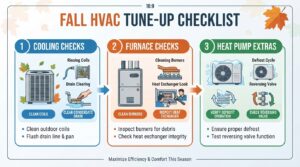
A heat pump does both jobs, so the fall visit covers the cooling checks above plus the items in the table below.
| System | Item | What the technician does |
| Cooling | Condenser coil | Rinse the outdoor coil and confirm airflow through the cabinet |
| Cooling | Refrigerant line insulation | Replace cracked or missing insulation on the suction line |
| Cooling | Capacitor and contactor | Test the capacitor and inspect contacts for pitting |
| Cooling | Condensate drain | Clear the drain, trap, and pan |
| Cooling | Blower and filter | Check the blower wheel, motor draw, and filter loading |
| Furnace | Burners and flame sensor | Clean the burners, verify the flame, clean the sensor |
| Furnace | Heat exchanger | Visual inspection for cracks, corrosion, and soot |
| Furnace | Ignition and safety controls | Test the igniter, limit, rollout, and pressure switches |
| Furnace | Venting and combustion air | Check flue pitch, blockage, and the intake path |
| Furnace | Gas connections | Leak check, then manifold pressure against the rating plate |
| Furnace | Carbon monoxide | Combustion analyzer reading at the flue |
| Heat pump | Reversing valve | Confirm the valve shifts and holds in both modes |
| Heat pump | Defrost cycle | Force a defrost and watch it complete and return to heating |
| Heat pump | Outdoor coil | Clean the coil and clear fall leaf debris |
| Heat pump | Auxiliary heat | Confirm strip heat operates and stages correctly |
| Heat pump | Refrigerant charge | Verify charge by superheat or subcooling |
| Heat pump | Thermostat changeover | Test the heating call and the homeowner’s schedule |
The reversing valve shifts the system between heating and cooling. A valve that sticks leaves the house cold while the outdoor unit runs normally, and homeowners usually blame the thermostat.
In heating mode, the outdoor coil frosts over, and the defrost cycle clears it. Our technicians force a defrost, watch it return to heating, and clean the coil with attention to the fall leaf drop.
Auxiliary heat carries the load on the coldest mornings, so its operation and staging get checked.
Charge gets verified by superheat or subcooling against the rating plate, since a heat pump that is low loses capacity in both modes. Thermostat changeover gets confirmed too, and the thermostats page covers replacement options.
What you can do the same day
Several items do not need a technician, and handling them now makes the visit shorter.
Filters. Change or clean every filter and check the size before buying, since a filter that ran all summer is loaded. Air filtration and indoor air quality products are worth asking about if dust bothers you.
Vents and registers. Confirm every supply and return is open. Furniture and rugs over a return starve the system.
Thermostat. Replace the batteries, then set the heating schedule. December is a bad month for learning the menu.
Outdoor unit. Keep two feet of clear space around the cabinet, trim the shrubs, and check that the unit sits level.
Test the heat. Run heating mode through a full cycle on a cool evening. A failure on a test run is an appointment. The same failure on the first freezing night is an emergency.
Carbon monoxide detectors. Install them on every level and outside each sleeping area, then test them. If you smell gas, leave the house and call for help from outside.
What a tune-up is not
It is not a repair guarantee. Our technicians can clean, test, and measure a system, and a part can still fail next month. What you get is equipment that starts the season clean and free of anything this inspection can catch.
A tune-up will not fix a failing compressor, a cracked heat exchanger, or a refrigerant leak. Those are repairs, quoted as repairs.
It is not a repair visit either. A repair visit starts with a problem and ends when it is solved, while a tune-up starts with a running system and looks for anything that would stop it.
| Point of comparison | Fall tune-up | Repair visit |
| Starting point | A system that runs | A system that does not run, or runs wrong |
| Goal | Prevent problems before the season starts | Diagnose and fix one specific failure |
| Scheduling | Booked ahead, normal hours | Often urgent, sometimes after hours |
| Scope | Full checklist across cooling and heating | Whatever the diagnosis points to |
| Result | A clean, tested system and a written list of findings | A working system, or a quote for replacement |
| If something turns up | Gets quoted and scheduled separately | Gets handled in the same visit when parts allow |
A real failure found during a tune-up is a repair, and the furnace repair page shows that visit.
Maintenance plans compared with one-off visits
That’s the real test of whether an HVAC maintenance plan is worth it: not the discount on one visit, but whether the second visit happens. One tune-up is better than none. A plan changes the arithmetic by putting the second visit on the calendar before the season that needs it.
A fall visit covers the heating side and gets you into winter. Many homeowners also want the cooling side checked in spring, which means a second appointment and a second fee. A plan typically bundles both visits.
Plans change scheduling too. Priority scheduling and waived diagnostic fees are common in a maintenance agreement, and both matter most when everyone else is calling at once.
What the True Blue maintenance plans and service agreements include is described on those pages, so see the maintenance plans page for current details about features and terms. Check the specials page for anything running now.
One more point. Most manufacturers expect documented annual maintenance for some coverage to remain valid, and the requirement depends on your equipment, so read your own warranty document.
How to book before the first cold stretch
Book in the last week of September or the first week of October. That matches the forecast above and gets you ahead of the rush instead of into it.
Waits grow once the temperature drops. The first cold morning produces more calls in a day than the previous two weeks combined, and non-emergency appointments move back to make room for the no-heat calls.
If your system has not been serviced in several years, or it has needed more than one repair lately, ask for a repair evaluation instead of a standard tune-up. Ongoing care is covered on the furnace maintenance page, the heat pump maintenance page, and the AC maintenance page.
Frequently asked questions
Q. Is a fall tune-up really necessary?
A.For most homes in this climate, yes, and the honest version depends on the equipment. On a system serviced every year, the fall visit is usually quick. On one that has gone several seasons without a look, it is where you find out what the summer did.
Q. What does an HVAC tune-up include?
A. The cooling side first, since the air conditioner just finished its hardest stretch of the year, then the heating side for your equipment. The checklist table above lists every item, from coil cleaning to the combustion reading on a furnace and the defrost cycle on a heat pump.
Q. How often should a heat pump be serviced?
A. Twice a year, because a heat pump runs in both directions. The fall visit prepares it for heating, and a spring visit handles the cooling side. Maintenance plans are built around those two visits.
Q. What happens if I skip it?
A. Nothing dramatic happens the next day if the system is healthy. What you lose is the chance to catch small problems early. A loaded filter, a slow drain, and a capacitor that is drifting keep working for a while and get worse in the background, so the failure usually surfaces on the coldest morning of the year.
Q. How long does a fall tune-up take?
A. We book tune-ups as scheduled appointments, and the time depends on the equipment and how accessible it is. Ask when you book, and we will give you a realistic window.
Q. My system has not been serviced in years. Is a tune-up enough?
A. Not always. If the equipment has been ignored for several seasons, or it has needed more than one repair recently, ask for a repair evaluation first. A tune-up assumes the system runs normally. An evaluation starts with what is wrong.
The cooling season is not finished in Middle Tennessee, but the switch is close. Call 615-568-7450 to schedule your fall HVAC tune-up, or use the contact page to request a time. The maintenance plans page shows what an agreement covers if you would rather stop booking this visit every year.